
Australia’s NEM sets minimum demand record as rooftop solar reaches 15GW
The distributed solar output demonstrates the growing influence of behind-the-meter generation on grid operations and system demand patterns. It is also worth noting that Australia’s installed rooftop solar PV capacity recently surpassed 26GW.
Renewable energy sources supplied 75.5% of total generation when the minimum demand record was established. Rooftop solar PV systems contributed 57.5% of total generation, while grid-scale solar provided 12.4% and wind generation added 5.6% to the renewable energy mix, as shown in the graph below.
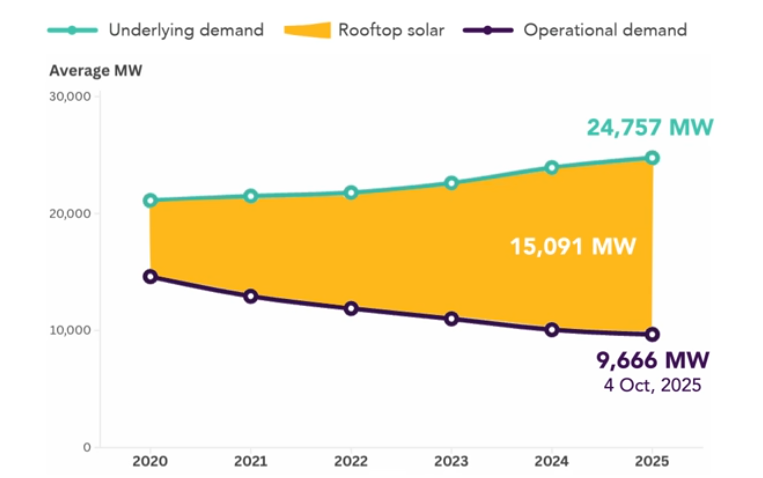
Minimum operational demand represents the lowest point of electricity demand that large-scale generators must meet after accounting for rooftop solar and other distributed energy resources.
The metric has become increasingly important for system operators managing grid stability as distributed generation capacity expands across the NEM.
The 15GW of rooftop solar recorded during the minimum demand period reflects the substantial growth in distributed solar PV installations across Australia’s eastern states. AEMO forecasts renewable energy generation will reach 229TWh by 2035, with distributed solar expected to play an increasingly significant role in meeting electricity demand.
Meanwhile, the declining minimum demand trend presents opportunities and challenges for grid operators. Lower operational demand reduces the need for large-scale generation during peak solar production periods, but as conventional generators reduce output, new requirements for system services, including frequency control and voltage support, are created.
Australia’s electricity system has experienced record-breaking growth in renewables and energy storage assets, with the integration of variable renewable energy sources requiring enhanced grid management capabilities.
However, this rapid rollout of renewable energy generation has meant that grid-scale solar facilities have faced operational challenges during periods of high renewable energy output, with curtailment levels exceeding 25% in 2024 as system operators manage oversupply conditions.
The combination of distributed and utility-scale solar generation during minimum demand periods illustrates the coordination required between renewable energy sources.
You can explore September’s solar generation performance in our latest NEM data spotlight, with all entries available to PV Tech Premium subscribers.