
Anti-Vaxxers Claim Deadly Measles Is Good for You
Welcome to Reality Check, NewsGuard’s newsletter that tracks the false claims and conspiracy theories that shape our world — and who’s behind them. Support us by becoming a premium member or sharing our work.
Follow us: X | LinkedIn | Instagram | Bluesky
As Measles Outbreak Grows, Anti-Vaxxers Claim Measles Prevents Cancer
By John Gregory
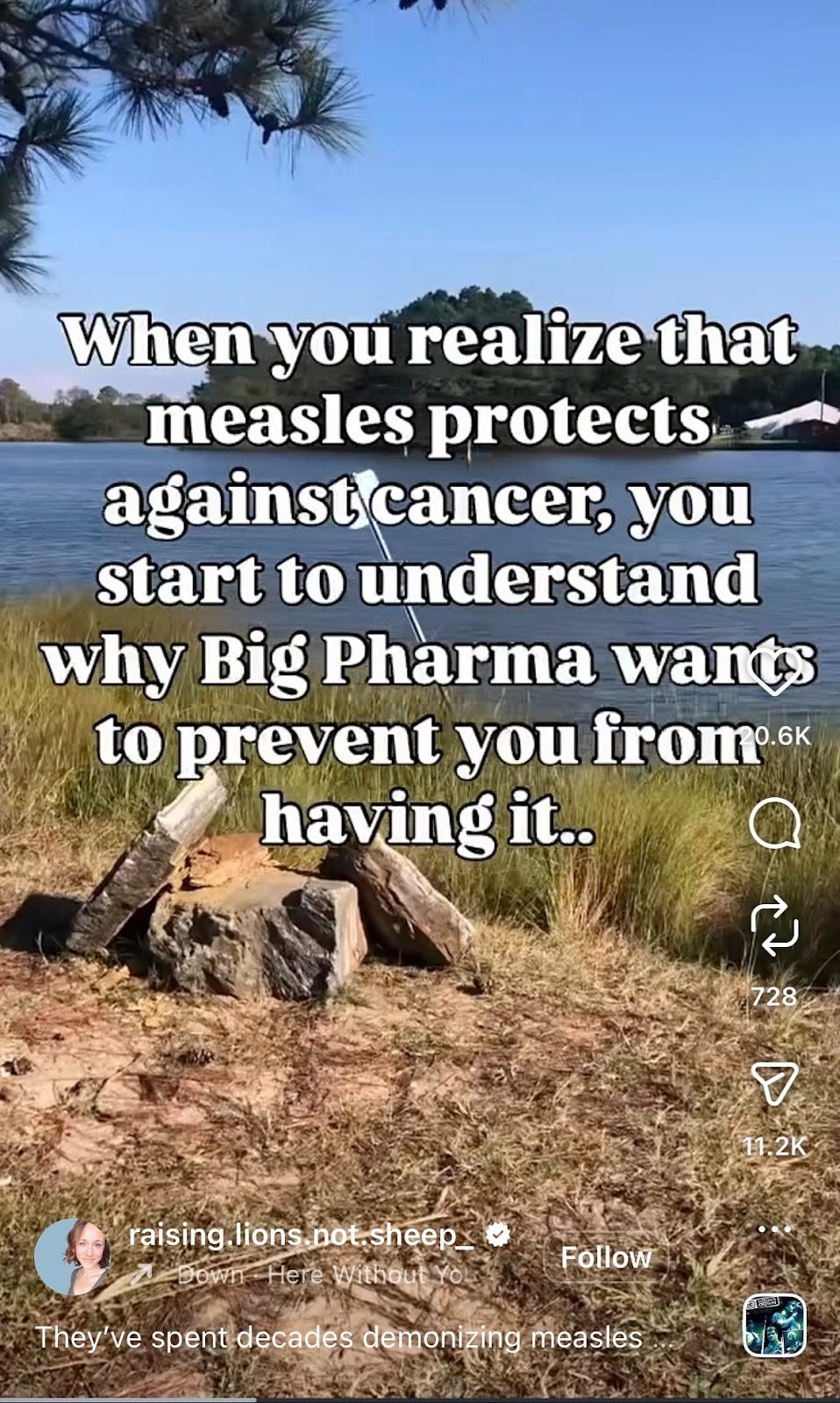
What’s happening: Anti-vaccine accounts on Instagram and X have revived the false claim that a measles infection, which is potentially deadly, actually provides health benefits, including long-term protection against cancer.
Context: The false narrative is resurfacing as the number of measles infections continues to rise in the U.S., with significant outbreaks in South Carolina and Florida, with other states also affected. Through Feb. 5, the U.S. Centers for Disease Control and Prevention has recorded 733 measles cases so far in 2026,
That’s more than the total number of measles cases reported between 2020 and 2024 combined.
A closer look: A Feb. 10 Instagram post by natural health influencer Alison Sadler (@raising.lions.not.sheep_) included video with text stating, “When you realize that measles protects against cancer, you start to understand why Big Pharma wants to prevent you from having it.” The video received 46,000 views in the first hour after it was posted, eventually racking up 870,000 views and 20,000 likes in two days.
The same video was posted by the Instagram account @freedom_knocks in July 2025, Agence France-Presse reported in a December 2025 fact-checking article. However, that post did not generate as much engagement as Sadler’s post, receiving 119,000 views and 3,000 likes as of Feb. 12.
The false claim was also pushed in a Feb. 7 post by the X account @thehealthb0t, which frequently shares false claims about vaccines. “What if getting measles as a kid PROTECTS you from heart disease and cancer later in life?,” the post asked. “Big Pharma won’t tell you this…” The post generated 96,000 views and 4,500 likes in five days.
The accounts cited above did not immediately respond to NewsGuard’s direct messages seeking comment.
Actually: Health experts consistently report there is no evidence that measles infections provide health benefits such as long-term protection against cancer and heart disease. On the contrary, measles can cause death or serious complications that can last long after a person has recovered from the infection, experts say.
Dr. Michael Mina, an epidemiologist and former professor at Harvard School of Public Health who has studied measles’ effects on the immune system, told FactCheck.org in a March 2025 article: “There is no good data to demonstrate that measles improved health. We’ve shown precisely the opposite.”
Sadler’s Feb. 10 Instagram post noted above cited preliminary Mayo Clinic research from 2014, which reported that an injection of an engineered measles virus — not one found in nature that causes measles outbreaks — led to two patients’ blood cancer going into remission.
However, those same Mayo Clinic researchers said that their work was not an endorsement of measles. “Having worked for many years to develop engineered measles viruses as anticancer therapies, we have concluded (1) that measles is not protective against cancer and (2) that its potential utility as a cancer therapy will be enhanced, not diminished, by prior vaccination,” the researchers wrote in a 2019 article in the peer-reviewed Mayo Clinic Proceedings journal.
Learn more about Reality Check’s Premium Membership here.
Oops! Chinese State-Linked Content Farms Caught Prompting AI Tool to Target Taiwanese
By Charlene Lin

What’s happening: Chinese state-linked content farms are using AI to target Taiwanese users with pro-China political messaging. How do we know? Because the content-creating operators inadvertently left the AI prompts they used to create the content at the bottom of their posts online. This marks the first time researchers have identified such clear evidence of AI use in texts targeting Taiwanese in Chinese influence operations.
A closer look: Austin Wang, an associate political scientist at the California-based global policy think tank RAND Corporation, identified AI prompts that explicitly request that AI chatbots target “Taiwanese users” in “Traditional Chinese” — the standard writing system used in Taiwan — in Facebook posts from Chinese-language content farms associated with China’s external propaganda office, according to an article by Wang on Taiwan Thinktank’s commentary site Voicettank. A content farm refers to social channels that mass produce low-quality posts to attract viewership.
The content farms are operated by Qinhuangdao Borderless Technology Co., Ltd., a Hebei-based company that uses Hong Kong VPNs to manage Facebook pages in China, where officially, the platform is banned, Wang found.
The pages typically post lifestyle content — such as quotes, historical biographies, and relationship anecdotes — or mimic Taiwanese community forums. Then, having gained a following from benign posts, they shift to political messaging during Taiwan’s election cycles, promoting pro-China candidates or spreading fabricated stories smearing Taiwan, according to news reports.
Wang found multiple examples of messages left at the bottom of posts that read as prompts used to generate the posts with AI.
For example, a Feb. 3, 2026, post by Facebook page “人物故事奇談 (Tales of Remarkable Figures)” about the revolutionary journey of a Chinese Communist Party veteran included a line saying, “For the Taiwanese audience, re-edit this article in Traditional Chinese. Limit it to 500 characters, retain the original opening section, and do not alter the historical accuracy of the original text.”
A Jan. 12, 2026, post by Facebook page “家裡那點事 (Little Things in Our Household)” focused on a fictional story about a relationship, included a line at the bottom, saying, “For the Taiwanese audience, re-edit this article in Traditional Chinese and limit it to 300 characters.” Wang said that he found in the post’s edit history that the AI prompt had been removed two minutes after the post was published.
Zooming out: Although researchers have long suspected that influence campaigns use AI to craft posts, this abuse of AI models is often difficult to prove. Most operations leave only circumstantial signals, such as unusually high posting volume or repetitive phrasing common to AI models.
As AI models become increasingly capable of producing natural-sounding text, such slip-ups may become rarer. But for now, they offer a window into how state-linked actors are using AI to influence targeted audiences.
You find, we report: Let your fellow Reality Check readers know about false claims you run across online. Our analysts debunk false claims before any others 80% of the time, but we can’t catch everything. If you find what looks like a false claim, let us know. We’ll investigate and report back in Reality Check.
Reality Check is produced by co-CEOs Steven Brill and Gordon Crovitz, and the NewsGuard team.
We launched Reality Check to shed light on the false claims spreading online, how they spread, and the forces behind them. Each day, we aim to bring you the story behind your news feed and help you stay informed about the false claims circulating in the news. Support our work by becoming a premium member.
Have feedback? Send us an email: realitycheck@newsguardtech.com.