
And the bad-take award goes to ...
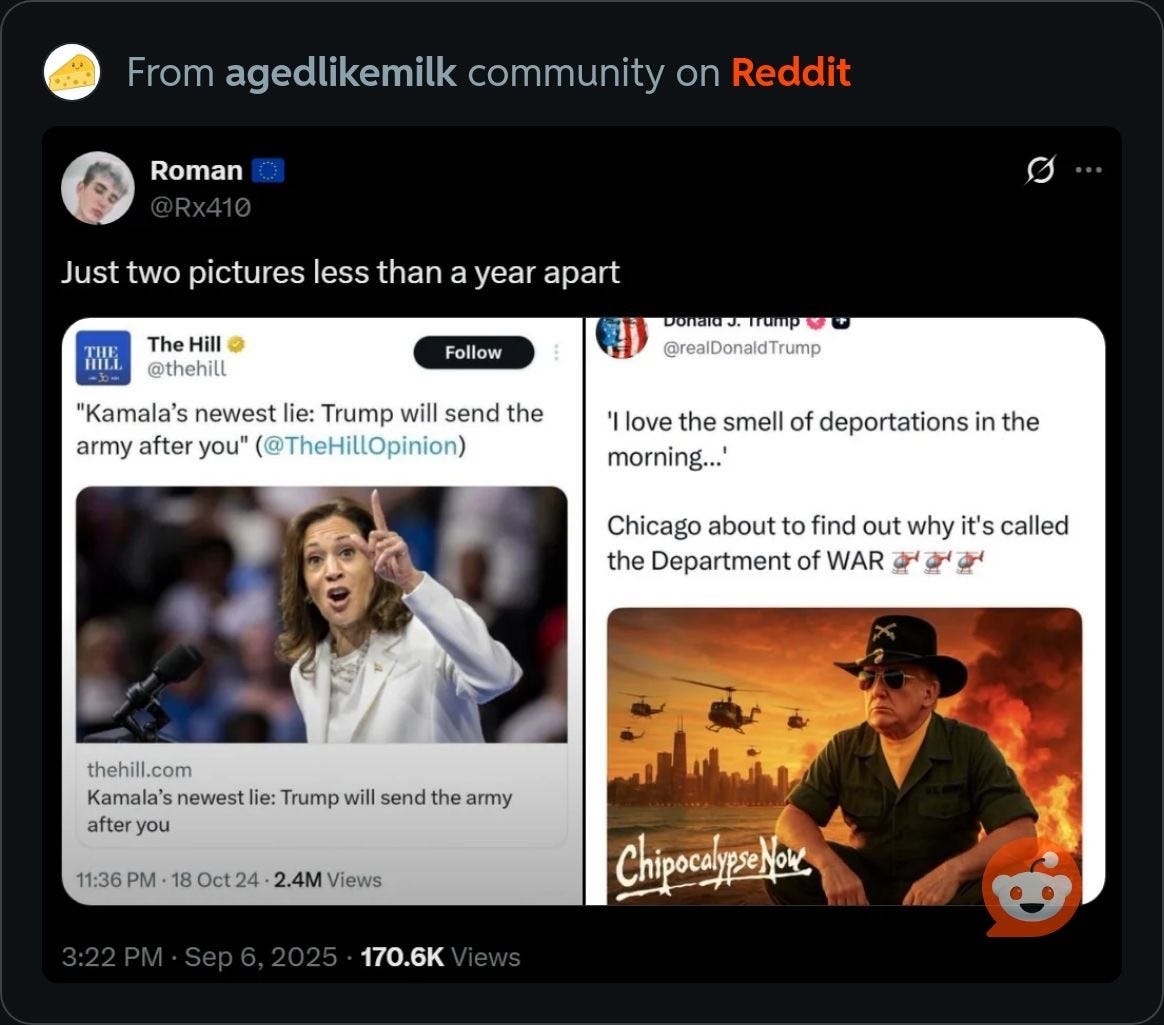
About a year ago, the Washington-based newspaper The Hill published a snide opinion piece.
Illustrated with an unflattering photograph of the Democratic presidential candidate, it carried the headline, “Kamala’s newest lie: Trump will send the army after you.”
Flash forward 11 months to Donald Trump’s shocking social-media meme of the weekend, warning that Chicago is about to “find out why it’s called Department of WAR.” Trump’s post also featured these ugly words, a twist on a line from the film Apocalypse Now: “I love the smell of deportations in the morning.”
The author of the 2024 opinion piece is Derek Hunter, a podcaster and former Republican Congressional staffer. It begins with a classic example of pro-Trump projection, “Vice President Kamala Harris sure lies a lot.”
Harris lies a lot?
Turns out Trump appears willing to do just what Hunter found so ridiculous, all in the service of deporting immigrants and invading a Democratic city. Chicago, the nation’s third-largest city, is in a blue state led by one of Trump’s most outspoken political opponents, Illinois governor JB Pritzker. The Philadelphia Inquirer’s outstanding national columnist Will Bunch described Trump’s meme (and what it threatens) as “a new low in the drive for U.S. dictatorship.”
Thus, I nominate that piece for the bad-take hall of fame, where it can live alongside Washington Post columnist Kathleen Parker’s infamous reassurance prior to the 2016 presidential election, headlined “Calm down. We’ll be fine no matter who wins.” (Parker had the grace in late 2020 to offer a mea culpa.)
Readers, do you have any nominees for bad takes — for stories or opinion pieces that aged about as well as 11-month-old milk? Send them my way.
American Crisis is a community-supported project where I explore how journalism can help save democracy. Please consider joining us!
Separately, I chatted Sunday with the great Julie K. Brown of the Miami Herald, who is well known for her reporting that helped to break open the Jeffrey Epstein scandal in 2018. She’s the author of the book Perversion of Justice, and the winner of two George Polk awards, second only to the Pulitzer Prize in the journalism world.
Among other things, we talked about her conviction that the accused sex trafficker did not commit suicide in prison, which was the official ruling; the absurdity of the Trumpian effort to persuade the public that all the Epstein files have been released; and the increasing difficulty of doing the kind of dogged reporting she did on Epstein when local newspapers are so tragically shrunken.
Julie’s most recent article describes how the Herald has teamed up with the New York Times to “follow the money,” as the time-honored journalism advice goes. The two papers are trying to get a judge to unseal financial records from Epstein’s estate in the U.S. Virgin Islands. Within her article (gift version here), Brown lists the government files that remain under lock and key.
She writes: “There are still a staggering number of records that have not been made public in the case.” Among them:
- Epstein’s draft 2008 indictment on sex-trafficking charges
- Search-warrant records for Epstein’s various properties in 2005 and 2019
- Evidence and statements gathered as part of the criminal cases against Epstein and Maxwell
- Lists of possible suspects involved in Epstein’s sex-trafficking network
- Witness statements
- Unredacted FBI vault case files
- CIA files
- Autopsy and underlying investigative interviews involving Epstein’s death
- Files kept by the Securities and Exchange Commission, Homeland Security and the Treasury Department
Brown told me that she has not seen any evidence connecting Trump to Epstein’s crimes. When I asked her which files she’d most like to get her hands on, she chose the FBI files from after the Epstein case was reopened in 2015. (Confidential sources, take note!)
Brown has been reporting this story for nearly a decade and there is no end in sight.
“The public and the victims deserve to know what went wrong” with the various failed prosecutions, she said, and with all aspects of the case. She keeps in touch with many of the victims she interviewed years ago, who were the key to breaking the story open, and she regrets that the endlessness of the case prolongs their trauma.
“We all have hope that we’ll get to the truth,” she said, pausing to add ruefully, “But maybe not in my lifetime.”
Here’s a link to Michelle Goldberg’s 2021 New York Times column arguing that local investigative journalism like Julie Brown’s is getting harder and harder to do as the local newspaper industry continues its tragic collapse. (Goldberg’s father, Jerry Goldberg, was a ranking editor at The Buffalo News during my tenure there; and Michelle herself grew up in the Buffalo area; she knows this subject well.)
One more note from Julie Brown is her observation that the high degree of interest in the Epstein saga is one of the few topics that most Americans are in agreement on. Let’s hope that this fine reporter is wrong in one respect and that it will be in her lifetime — and soon — that the full truth will be out.
And let’s hope, too, that local investigative journalism continues to do its job. That work is such a critical foundation for what remains of American democracy and for any hope of reclaiming it.
Thanks so much to all of you for your interest and support. It truly means a lot. I appreciated your excellent suggestions in the comments to last week’s post about organizations that are protecting voter rights and helping to right the ship.
Below this new subscriber’s reason for joining up is some information for newcomers about me and my mission for American Crisis.
My background: I am a Lackawanna, NY native who started my career as a summer intern at the Buffalo News, my hometown daily. After years as a reporter and editor, I was named the paper’s first woman editor in chief in 1999, and ran the 200-person newsroom for almost 13 years. Starting in 2012, I served as the first woman “public editor” of the New York Times — an internal media critic and reader representative — and later was the media columnist for the Washington Post. These days, I write here on Substack, as well as for the Guardian US, and teach an ethics course at Columbia Journalism School. I’ve also written two books and won a few awards, including three for defending First Amendment principles.
The purpose of ‘American Crisis’: My aim is to use this newsletter (it started as a podcast in 2023) to push for the kind of journalism we need for our democracy to function — journalism that is accurate, fair, mission-driven and public-spirited. That means that I point out the media’s flaws and failures when necessary.
What I ask of you: Last fall, I removed the paywall so that everyone could read and comment. I thought it was important in this dire moment and might be helpful. If you are able to subscribe at $50 a year or $8 a month, or upgrade your unpaid subscription, that will help to support this venture — and keep it going for all. Thank you!
Related Knowledge Center: Inside the newsroom
As newsrooms struggle with rickety business models and precarious finances — as well as new technologies — they are deploying an array of editorial responses.
The Times and its critics | Washington Post mortem