
Amid media failures and flaws, five things to celebrate
I’m writing this just an hour or so after the precise moment of the winter solstice — that yearly event when the Earth’s axis tilts the farthest from the sun. Yes, it’s pretty dark on these short days, but from now on, longer days are coming. And I hope better times in other ways, too.
With that in mind, I’ll offer some developments or moments in the world of media (and in one case technology) that give me cheer.
- This isn’t exactly media, but perhaps close enough. Certainly, it’s hopeful. As you may know, New York State banned phones in public schools this past semester, to much grumbling from kids who were used to being glued to their devices. Now, months later, New York magazine reports that while the initial goal was undistracted learning, “within weeks of the Great Phone Lockup, teachers began to notice an incidental (and arguably, even more compelling) benefit: The teens were talking to one another … there’s a pleasant buzz in the lunchroom, chatter in the hallways,” and a bunch of new analog hobbies — card games, board games and new friendships. Here’s what one Harlem high school senior said: “We’ve had a lot more school spirit. People are more willing to do stuff.” I’d call that a win, and an important one.
- For all the criticism of the Washington Post (mostly the editorial pages), the Post newsroom, with its hundreds of top journalists, continues to do great work. Last Thursday night, I was texting with my friend Laura, a longtime journalist, as social media swirled with a new round of rumors about the gunman in the Brown University shooting. Had the suspect committed suicide? Was there really a link between those deaths on campus in Providence and the murder of an MIT professor? She summed up the chaos: “Shooter grey rental Nissan New Hampshire something …” I responded: “Awaiting some form of actual reporting” and added “Maybe I’ll just read about it in the morning.” And first thing in the morning, I found the Post’s coverage, headlined “Brown U. And MIT professor shootings are linked; suspect found dead, officials say.” The story (here’s a gift link) bore five bylines, with eight more contributors. Talk about a team effort and an expert one. It was crisp, thorough, well edited, and sensible. I was grateful, and as Laura noted after reading it, “It’s a relief to know this kind of reporting/editing is still out there.” Credit where due. I also appreciated (and readers, I don’t know how you feel about this but I am interested) that it was a traditional article. It was not in the form of a live blog with various new developments piled on top of others, with no sense made of it. If I wanted that, I’d just go back to social media.
- The Media and Democracy Project put out its year-end list of exemplary individuals and publications, honored for their commitment to journalism, democracy and press freedom. Among the heroes: the Associated Press, which refused to change their style guide at Trump’s whim to rename the Gulf of Mexico. When the White House punished the AP by withdrawing access, the AP sued the administration. Other honorees included Ann Telnaes, Ruth Marcus and Karen Attiah, all formerly of the Washington Post opinion section; Scott Pelley of CBS News; Mary Bruce of ABC News; Will Bunch of the Philadelphia Inquirer and Adam Zyglis of the Buffalo News. There’s more. You can check it out here.
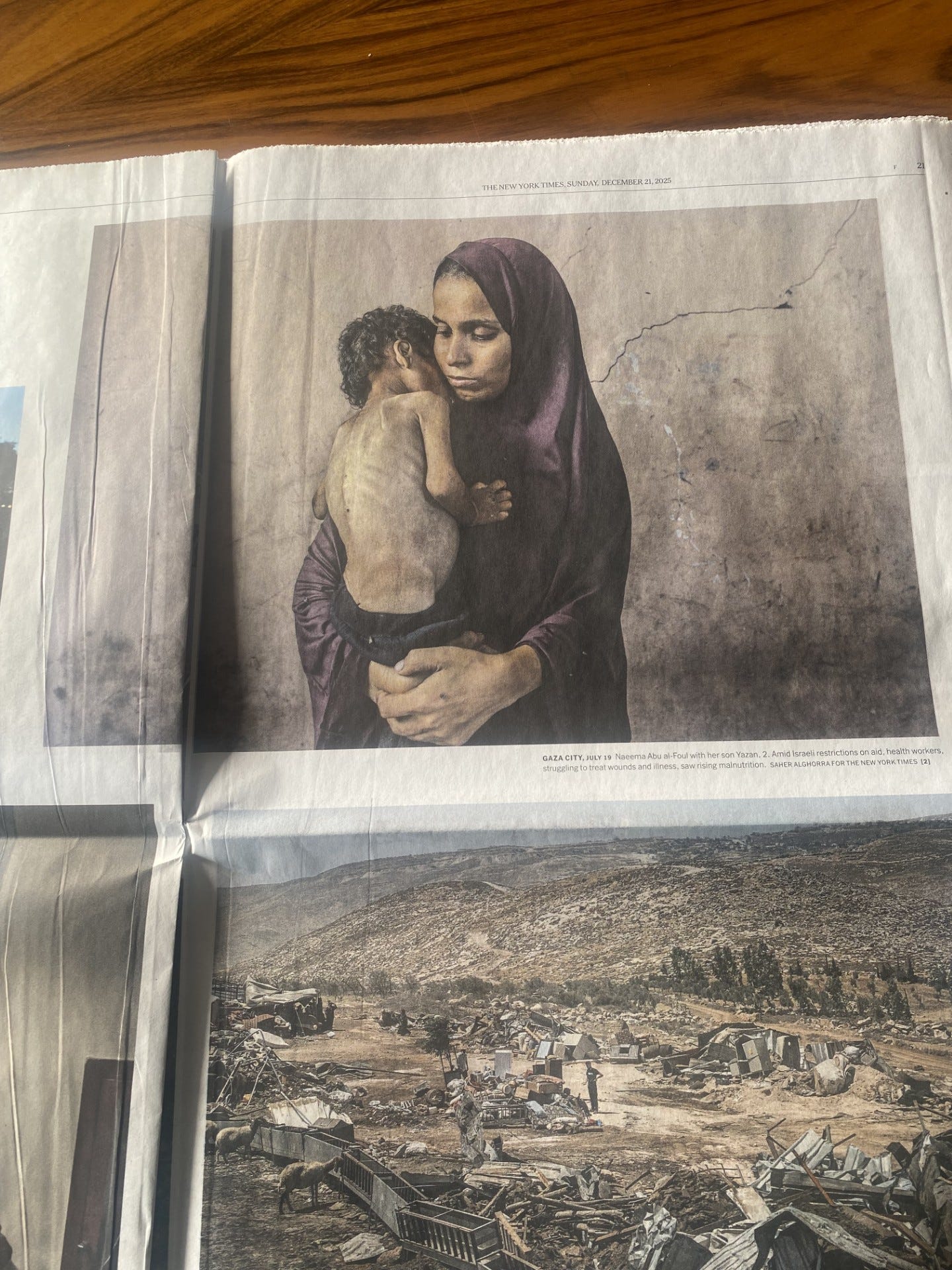
I’ve mentioned this before but it bears repeating — New York Times newsroom lawyer David McCraw is an eloquent spokesman for press rights under siege. As the Times, too, refuses to buckle under to the Trump administration’s punitive measures, he’s been making the case publicly. I saw him recently on NY1, the local cable-news channel, explaining why to anchor Annika Pergament. Also, praiseworthy from the Times (which I spend a lot of time here criticizing), a special print section in the Sunday paper, The Year in Pictures, which is impressive, as always. You can also, of course, see it on line. I was especially moved by this photo from Gaza City in July by Saher Alghorra of a mother holding her emaciated two-year-old son. Here’s a gift link to the photos.
I taught my last class at Columbia Journalism School last week, and as always, was heartened by the quality and the passion for journalism of my graduate students. This was the “ethics essentials” class in which we had considered such current situations as Olivia Nuzzi’s affair with RFK Jr and the coverage of the Jeffrey Epstein files, as well as ethical failures and quandaries over the decades. I took a few minutes at the end of class to give them some advice. I told them to do their own work (yes, especially in the age of AI), to heed their own moral compasses, to understand that they will make mistakes and to get past them by ‘fessing up and making amends, and to keep at their craft — to be persistent, productive, energetic, even driven. I told them to read widely and be inspired by the best, to be prepared to change as the industry changes, to stay humble, and to remember that their job isn’t self-glorification but to fulfill the public-interest mission. I know there are many journalists among the readers of American Crisis. Please tell me in the comments here what advice you would give aspiring journalists.
American Crisis is a community-supported project where I explore how journalism can help save democracy. Please consider joining us!
Separately, I wrote about the tug-of-war over CNN by the various huge corporate entities, and the harm that all this media consolidation does, and I pointed to some ways to begin repairing the situation.
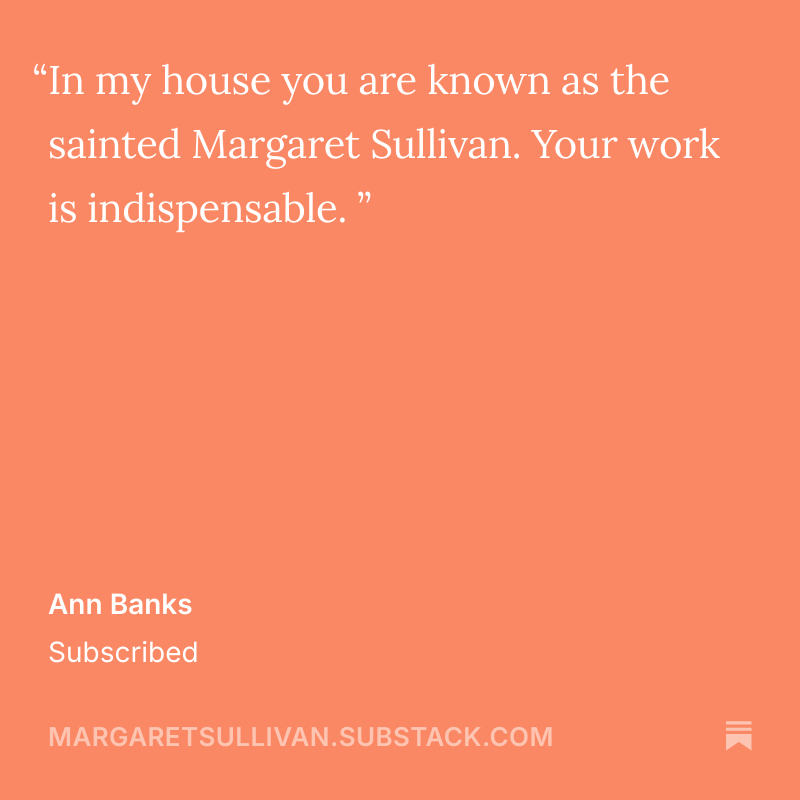
Readers, thank you so very much for being here, for reading and for commenting. Sometimes readers will leave a message about why they’ve decided to become paid subscribers. This one, just below, made me laugh (but thank you, Ann Banks). As the year draws to a close, I’m deeply grateful to have 51,000 total subscribers, more than double the number of a year ago. It’s an honor to land in your email inboxes and to hear from you in the comments. There is no paywall here. With your help, I hope to keep it that way for all, as I explain below. Have a joyful, restful and safe holiday season.
My background: I am a Lackawanna, NY native who started my career as a summer intern at the Buffalo News, my hometown daily. After years as a reporter and editor, I was named the paper’s first woman editor in chief in 1999, and ran the 200-person newsroom for almost 13 years. Starting in 2012, I served as the first woman “public editor” of the New York Times — an internal media critic and reader representative — and later was the media columnist for the Washington Post. These days, I write here on Substack, as well as for the Guardian US, and teach an ethics course at Columbia Journalism School. I’ve also written two books and won a few awards, including three for defending First Amendment principles.
The purpose of ‘American Crisis’: My aim is to use this newsletter (it started as a podcast in 2023) to push for the kind of journalism we need for our democracy to function — journalism that is accurate, fair, mission-driven and public-spirited. That means that I point out the media’s flaws and failures when necessary.
What I ask of you: Last fall, I removed the paywall so that everyone could read and comment. I thought it was important in this dire moment and might be helpful. If you are able to subscribe at $50 a year or $8 a month, or upgrade your unpaid subscription, that will help to support this venture — and keep it going for all. Thank you!
Related Knowledge Center: Inside the newsroom
As newsrooms struggle with rickety business models and precarious finances — as well as new technologies — they are deploying an array of editorial responses.
The Times and its critics | Washington Post mortem