
An American River: What are communities across the country doing to save our rivers?
The Delaware River begins in New York’s Catskill Mountains. On a tributary called the Beaver Kill, the water temperature is rising. That’s a problem for the fish and people like Brian Sheppard.
Sheppard said learning to fish saved his life. Now, as a fishing guide on the Beaver Kill, he shares his passion for fly fishing with clients. But as climate change makes the river warmer, he’s not sure how much longer he’ll be able to do that.
“I would say that there’s a ticking clock of 5 to 10 years where we’re gonna have to start to branch out and find other water, so I don’t necessarily know that it’s a long-term thing,” Sheppard said.
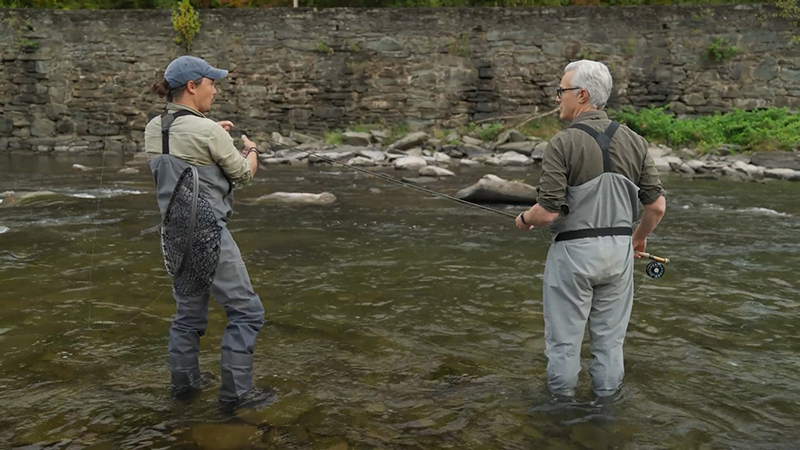
Brian Sheppard shows CBS News’ David Schechter how to fly fish.
Fly fishing is a $750 million industry in the U.S. As the climate continues to change, one study found 87% of rivers studied in America and Europe are warming — 70% are losing oxygen, which is threatening fish and the environment and economies that revolve around them.
“The insects are triggered by different temperatures as well, and so if the water temperature climbs too high, the bugs don’t hatch, the fish aren’t there to eat them, so it affects the whole chain of events that goes on to the eagles, the ospreys, the bears, the rest of the life that we have up here,” Sheppard said.
Jeff Skelding, executive director of Friends of the Upper Delaware River, said helping the fish also helps the people. His organization is trying to help restore the flow of the water by removing sediment and clearing old dams. This cools down the water and makes it more hospitable to the fish.
“This is not just a story about fish, it’s also a story about people. … All kinds of recreational activities, increasingly, are supporting the economies of these communities,” Skelding said. “So, these small tributaries are the lifeblood of the whole system. We’ve got to keep them clean to keep everything else clean.”