
AIKO’s ultra-light solar panel answers structural load limit problem
Pilot shipments of AIKO’s ultra-light 8.6 kilogram solar panel have arrived in Australia offering a solution to structural load limits common in old warehouses, cold stores and lightweight rooftops.
Chinese solar cell and module maker Aiko has introduced its ultra-light Nebular 8.6 kilogram solar panel into the Australian market offering a commercial and industrial (C&I) solution to structural load limits.
Claiming a 60% lighter weight advantage over standard mono-glass modules, AIKO says the 435 W to 450 W Nebular is the first light-weight module in the world to feature a reinforced standard frame with a glass-free design, enabling rooftop solar installation without adhesives or custom racking.
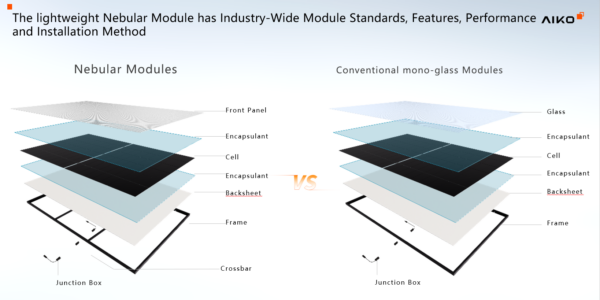
Image: AIKO
This combination reduces weight and lowers the risk of microcracks and roof damage, particularly on older or lightweight structures.
AIKO’s Head of Australia New Zealand (ANZ) Thomas Bywater said many businesses have been eager to adopt solar but have faced physical and financial barriers due to roof weight limitations.
“Nebular eliminates this challenge, making high-performance solar accessible to more businesses, helping reduce energy costs, and accelerating Australia’s transition to clean energy,” Bywater said.

Emailed to EF 8/4/25 via DC from Linh Pham, linh.pham@aikosolar.com
AIKO says for low-load rooftops the 2P mono-facial Nebular module makes solar more accessible for warehouses, carports, and retrofit projects without added time, labour, or system cost.
Built on AIKO’s proprietary ABC (All Back Contact) technology, Nebular modules offer up to 440 W output at 22% efficiency, better temperature and shading tolerance, and low long-term degradation.
By eliminating front-side busbars, ABC technology maximises light absorption, providing optimal power generation with a best-in-class weight-to-performance ratio.
It also features an improved anti-glare surface, making it suitable for sensitive environments like airports, highways, and urban areas.
This content is protected by copyright and may not be reused. If you want to cooperate with us and would like to reuse some of our content, please contact: editors@pv-magazine.com.