
3 Stocks to Benefit from the Rising Crude Oil Price
3 Stocks to Benefit from the Rising Crude Oil Price
Jun 17, 2025
 Image source: MicroStockHub/www.istockphoto.com
Crude oil prices are rising again.
The conflict between Israel and Iran has put the oil market on tenterhooks.
WTI crude has soared from close to US$ 60 per barrel at the end of May to US$ 72 per barrel now. That’s a 20% gain in less than three weeks.
Brent crude which is more relevant for calculating India’s average crude oil price, has gone up similarly from around US$ 63 per barrel to almost US$ 74 per barrel.
At the time of writing, no one is certain how the war will play out, how long it will last, what the end result will look like, and so on.
At least so far, oil trade through the middle east had not been affected. But both nations have attacked each other’s oil and gas infrastructure… and this has caused concern.
There are also reports of oil tankers colliding with each other on the crucial strait of Hormuz, although this incident may not be related to the ongoing war.
Clearly, crude oil speculators are on their toes, attempting to profit from price fluctuations.
But what about Indian companies. How are they affected?
India’s Crude Oil Imports
India imports almost 90% of its crude oil, most of it from the Middle East.
Thus, any disruption in oil supplies will be a big blow to the Indian economy.
However, even if there is no disruption, a spike in crude oil prices will be enough to hurt the economy.
Most companies in India are consumers of energy and are impacted negatively when crude oil rise.
There are very few companies that actually benefit from rising oil prices in India and even in those cases, there are caveats involved.
Let’s look at three examples in this editorial…
#1 ONGC
ONGC is the most obvious example of an Indian company benefiting from rising crude oil prices as it’s India’s largest oil and gas exploration and production company.
It’s a dominant player in India’s energy sector, contributing around 70-71% of the country’s domestic crude oil production and about 84% of natural gas production.
The Maharatna PSU is vertically integrated across the entire oil and gas industry, involved in exploration, development, and production activities across basins in India.
As crude prices rise globally, ONGC can sell its crude oil at higher prices. This directly boosts its revenue and profit margins.
For every US$ 1 per barrel increase in crude prices, ONGC’s annual revenue can increase by approximately Rs 3-4 billion (bn).
If the Israel-Iran conflict prolongs or escalates, crude oil prices are likely to remain elevated longer. This should benefit ONGC.
However, it should be noted here that the Indian government will, most likely, not let the domestic prices of various fuels rise too much. Thus, oil marketing companies will have to share the burden if prices are capped, either directly or indirectly.
In such a scenario, the company’s profitability could be affected.
ONGC Share Price — 1 Month
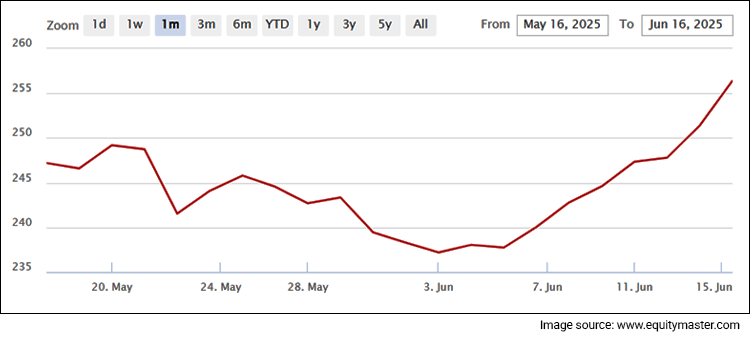
Recently, ONGC made promising new oil and gas discoveries in the Mumbai Offshore basin. This is expected to boost its production capacity.
ONGC also plans to double its natural gas production over the next 5-6 years, aligning with the Indian government’s vision to increase the share of gas in the energy basket from 6.5% to 15%.
The company is expanding in the green energy sector too. It has set an ambitious target to build a renewable energy portfolio of 10 gigawatts (GW) by 2030.
To know more, check out ONGC fact sheet and latest quarterly results. You can also compare ONGC with its peers on our website.
#2 Oil India Ltd (OIL)
Oil India is the country’s second-largest national oil explorer, with deep roots in Assam and an expanding footprint across India’s energy landscape. It plays a key role in India’s energy security.
Financially, Oil India has delivered a 5-year revenue CAGR of 15.8% and net profit CAGR of 16.6% between FY20-24. Over the same period, its average ROE stood at 20.2% and ROCE at 17.8%, impressive for a company navigating declining fields and volatile crude prices.
Looking ahead, the north-eastern gas grid and new well gas pricing promise a step-up in volumes and margins. The company is also aggressively exploring high-potential areas like Barekuri and ramping up seismic surveys to bring new discoveries into production.
OIL India Share Price — 1 Month
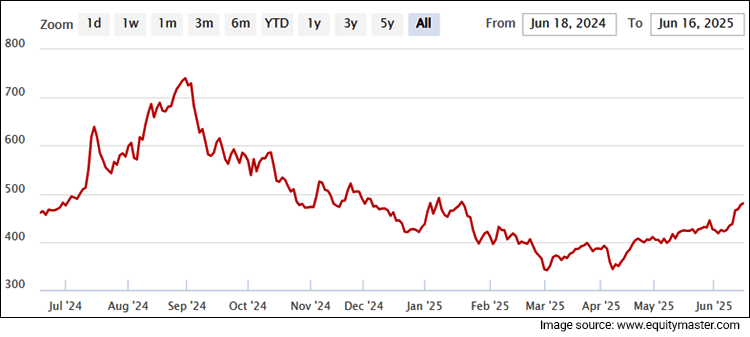
As oil prices rise, Oil India’s ramping output and disciplined capex of Rs 230 bn on the NRL and gas projects ensure it has plenty of fuel to keep the growth engine running.
Also, Oil India has broken new ground by striking oil in the north bank of the Brahmaputra for the first time in decades.
To know more about the company, check out its financial factsheet and latest quarterly results.
#3 Chennai Petroleum Corporation
Chennai Petroleum Corporation Ltd (CPCL) is one of India’s leading refiners.
A subsidiary of Indian Oil Corporation and a crucial player in South India’s fuel supply chain, the company is a key contributor to the nation’s energy basket, with a refining capacity of 11.5 MMTPA.
Financially, Chennai Petroleum has delivered a 5-year revenue CAGR of 11.9%, with an average ROE of 29.4% (though skewed by exceptional years) and ROCE averaging 23% across FY20-FY24.
Rising crude prices could be positive for the company. However, FY25 was a challenging year for the company. Its gross refining margins (GRMs) halved to US$ 4.22/bbl from US$ 8.64/bbl last year, driven by weaker global product cracks.
Inventory losses and rising debt levels also weighed on profitability despite strong capacity utilisation.
Chennai Petroleum Share Price — 1 Month
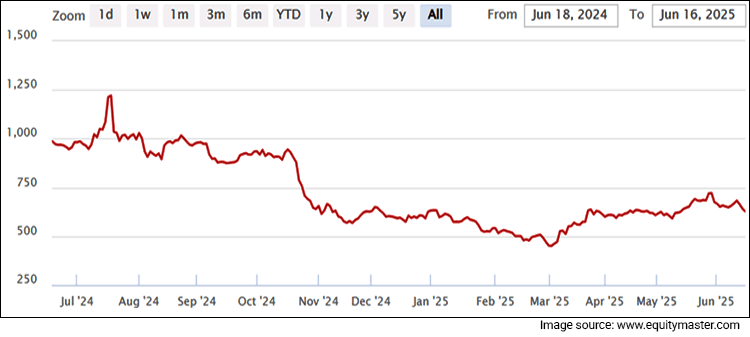
Looking ahead, the Rs 363.5 bn Cauvery Basin Refinery project (in JV with IOC) will add 9 MMTPA of capacity, with a 6% petrochemical index, marking CPCL’s entry into high-value petrochemicals.
The upcoming Lube Oil Base Stock (LOBS) project and ongoing debottlenecking upgrades will further lift margins, with expected annual capex of Rs 20-30 bn including major projects.
To know more about the company, check out its financial factsheet and latest quarterly results.
Conclusion
For upstream firms, earnings will be impacted positively by rising crude oil prices. For every US$ 5/bbl move in Brent crude, the corresponding hit to the earnings per share (EPS) is around 8-10%.
Even so, these companies aren’t just clinging on hope of oil prices recovering. They are leaning into production growth, exploration and energy transition bets.
For investors, the key will be to watch how well these companies execute on their growth plans, manage costs, and adapt to shifting market dynamics.
By staying selective and focused, investors can tap into the long-term potential of these energy players while keeping an eye on the inherent risks of the commodity cycle.
Investors should evaluate the company’s fundamentals, corporate governance, and valuations of the stock as key factors when conducting due diligence before making investment decisions.
To know what’s moving the Indian stock markets today, check out the most recent share market updates here.
Happy investing.
– Advertisement –
Investment in securities market are subject to market risks. Read all the related documents carefully before investing
Emerging Investing Opportunities in Midcap Stocks
With two decades of experience in the market, our co-head of research Rahul Shah can spot midcap stocks at the cusp of growth.
His research service, Midcap Value Alert, aims to recommend emerging investing opportunities in midcaps.
Try it for 30 days with 100% money-back guarantee
Try Our Midcap Stocks Research Today
Details of our SEBI Research Analyst registration are mentioned on our website — www.equitymaster.com
–––––––––––––––––
Disclaimer: This article is for information purposes only. It is not a stock recommendation and should not be treated as such. Learn more about our recommendation services here…